Revelation fight over Olympia
The revelation fight over Olympia is the catastrophic climax of E. T. A. Hoffmann's 'The Sandman', the moment when the uncanny truth behind the story's central mystery is violently unmasked and Nathaniel's psyche shatters irreparably. In a single, brutal scene, the two men who created the automaton — Professor Spalanzani and the sinister lens-grinder Giuseppe Coppola, who is also the childhood nightmare Coppelius — turn from collaborators into mortal enemies, and their struggle over Olympia's body reveals her to be nothing but a mechanical doll, a revelation that drives Nathaniel into raving madness and sets the stage for his suicide.
The Sound of the Struggle
Even before Nathaniel enters the room, the evidence of a violent conflict reaches him from the doorstep and the vestibule of Spalanzani's house. He hears a strange din: a stamping of feet, a clatter, a shoving, a pounding on the door, interspersed with coarse words and hurled imprecations. The voices of Spalanzani and the disgusting Coppelius screech and rage at each other. Spalanzani shouts, 'Let go! Let me go! You wretch! You cursed creature! Did I put my life and limb on the line for that?' Coppelius responds with a laugh, 'Ha ha ha ha! — that was not our arrangement — it was me, me who made the eyes!' Spalanzani counters, 'And I the mechanical clockwork!' The exchange escalates into a torrent of insults: 'Poor devil with your clockwork — you filthy cur of a simple-minded clockmaker!' — 'Get out! — Satan! — Stop!' — 'Organ grinder!' — 'Devilish beast! — Stop — Get out — Let go!'
The Physical Tearing Apart of Olympia
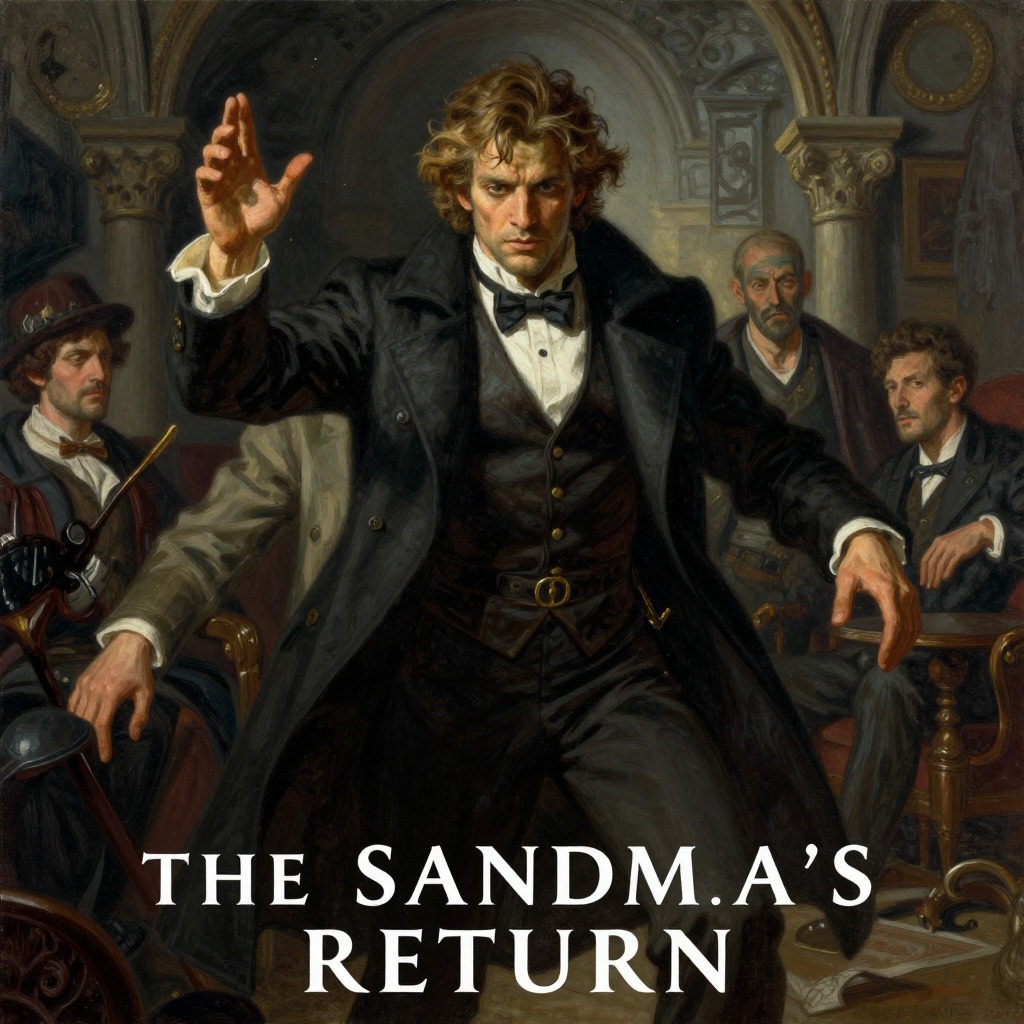
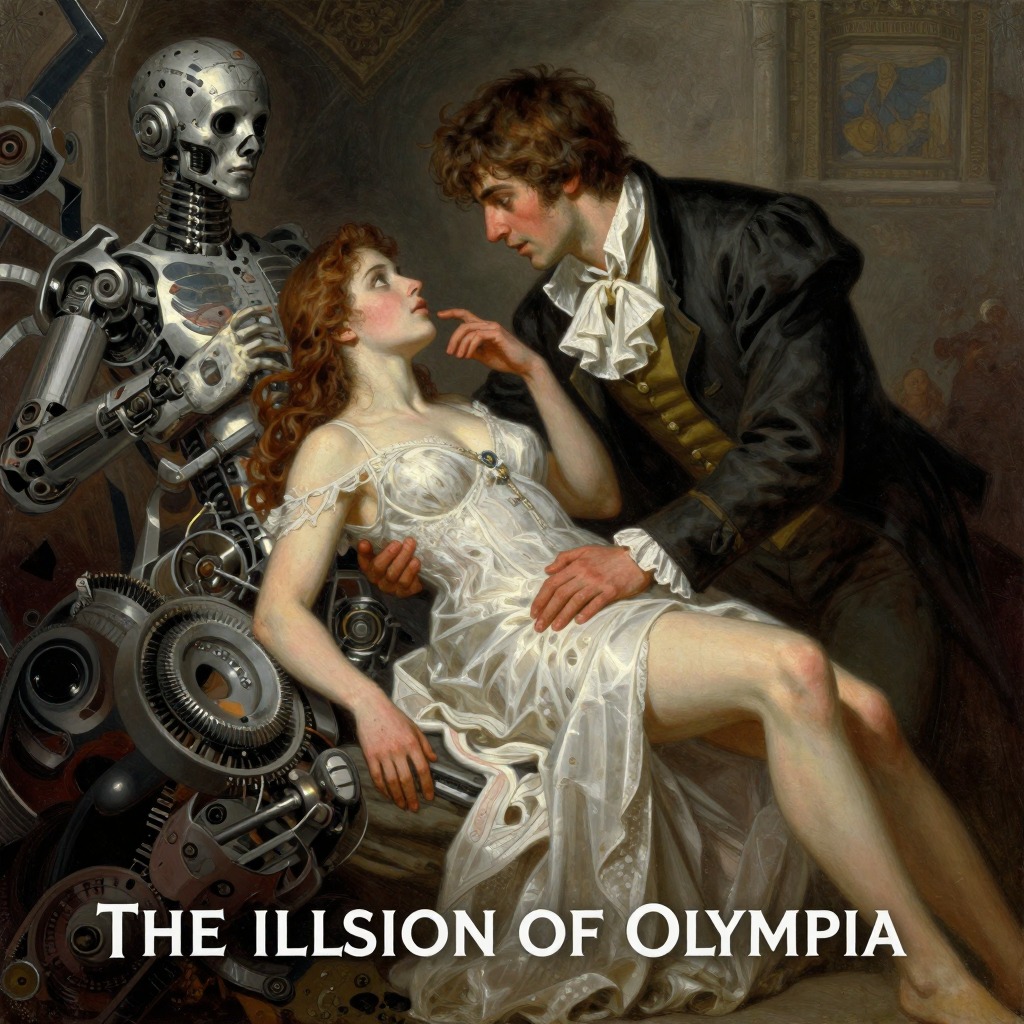
Gripped by unspeakable terror, Nathaniel bursts into the study. What he sees there is a grotesque tug-of-war over the female figure he believed to be his beloved. The Professor holds the figure by the shoulders, while the Italian Coppola holds her by the feet; they tug and tear her here and there, furiously fighting for possession. Nathaniel recoils in profound horror when he recognizes the figure as Olympia. Flaring up in a wild fit of anger, he is about to tear his beloved out of their struggling grip, but at that very moment, with a mighty burst of strength, Coppola manages to yank the figure free from the Professor's hands. With a pivot, swinging her in his direction, Coppola lands Nathaniel such a stunning blow that it makes him tumble backwards over the work table, toppling and knocking down phials, retorts, bottles, and measuring glasses, all of which smash in a thousand pieces on the floor. Then Coppola flings the figure over his shoulder and races down the steps with a repulsive, shrill laugh, so that the ugly dangling feet of the figure bang with a wooden thud and thump on the steps.
The Unmasking and the Eyes
Stunned, Nathaniel stands up. He has seen all too clearly that Olympia's deathly pallid wax face has no eyes, but black hollows in their stead; she is a lifeless doll. Spalanzani thrashes around on the floor, his head, chest, and arms cut by glass shards, blood spurting as though from a fountain. But he pulls himself together and cries out, 'After him — after him — why do you waver? Coppelius — Coppelius has robbed me of my finest automaton — twenty years' work — life and limb invested — the clockwork — speech — step — all mine — the eyes — the eyes robbed from you. Cursed hellhound! After him — fetch me back Olympia — there are her eyes!' Then Nathaniel spots a pair of bloody eyes peering at him from the floor. Spalanzani grasps them with his uninjured hand and flings them at him so that they strike him on the breast. This final, visceral assault — the eyes that had once seemed to gaze at him with love now hurled as bloody projectiles — is the trigger that shatters his mind completely.
The Descent into Madness
Madness grabs Nathaniel with its burning claws and bores its way into his heart of hearts, tearing his thinking and feeling to shreds. He begins to shriek, 'Hopla — hopla — hopla! — ring of fire — ring of fire! Spin around, ring of fire — merrily — merrily! — wooden doll, hopla, lovely little wooden doll — turn turn!' He flings himself at the Professor and presses his fingers to his throat, attempting to strangle him. Roused by the racket, many people storm in, tear the raging Nathaniel from the Professor's neck, manage to revive the old man, and thereby save his life. Siegmund, Nathaniel's friend, is not able to restrain the madman, who keeps on screaming in a terrifying voice, 'Wooden doll, turn, turn!' and lashes about him with balled fists. Finally, it takes the combined strength of many men to overpower him, fling him to the floor, and tie him up. His words dissolve into a terrible beastly bellowing. In this pitiful state, still raving in a ghastly frenzy, he is taken to the madhouse.
The Aftermath and the Pattern of Repetition
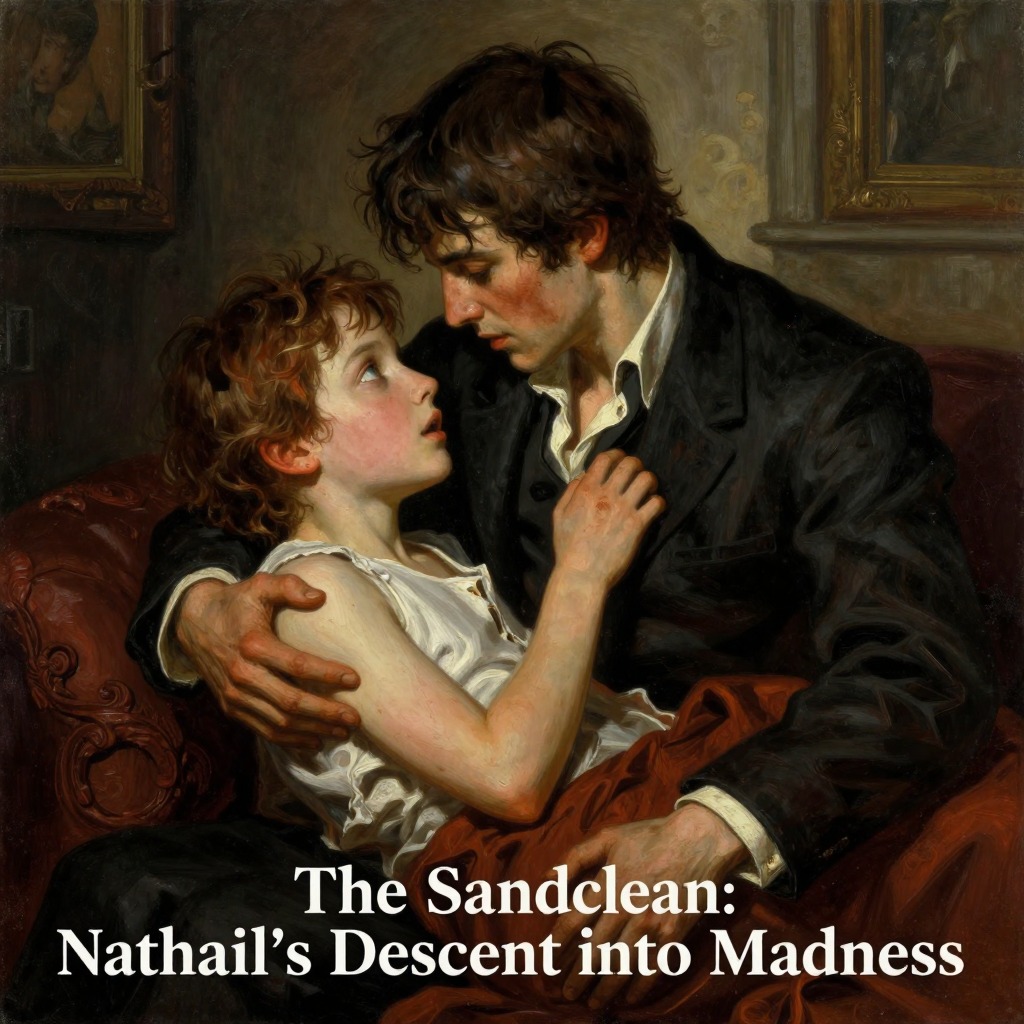
The revelation fight over Olympia is the second time in Nathaniel's life that a violent confrontation with Coppelius has ended with a father figure lying wounded or dead and Nathaniel himself reduced to a helpless, unconscious state. In his childhood, Coppelius had hurled him at the hearth, singeing his hair, and had twisted his hands and feet, and only his father's pleading — 'Master! Master! Let my Nathaniel keep his eyes!' — had saved him from having glowing cinders strewn into his eyes. That earlier scene ended with Nathaniel in a deathlike sleep, awakening to his mother's kiss. Now, the pattern repeats with a fatal difference: there is no father to intervene, and the eyes that Coppelius and Spalanzani fight over are not Nathaniel's own but Olympia's, yet they are flung at his breast as if to reclaim what was always at stake. The scene thus functions as a traumatic repetition, a return of the repressed childhood terror that the adult Nathaniel could never fully banish, and it completes the destruction of his reason.